
Crying and your baby
Why babies cry, characteristics and coping mechanisms.
Babies cry for many reasons and some of these may include:
- having a wet or dirty nappy
- needing a feed
- needing winded
- being hot or cold
- being bored
- being overstimulated
- being tired
On this page
How long do babies cry for?
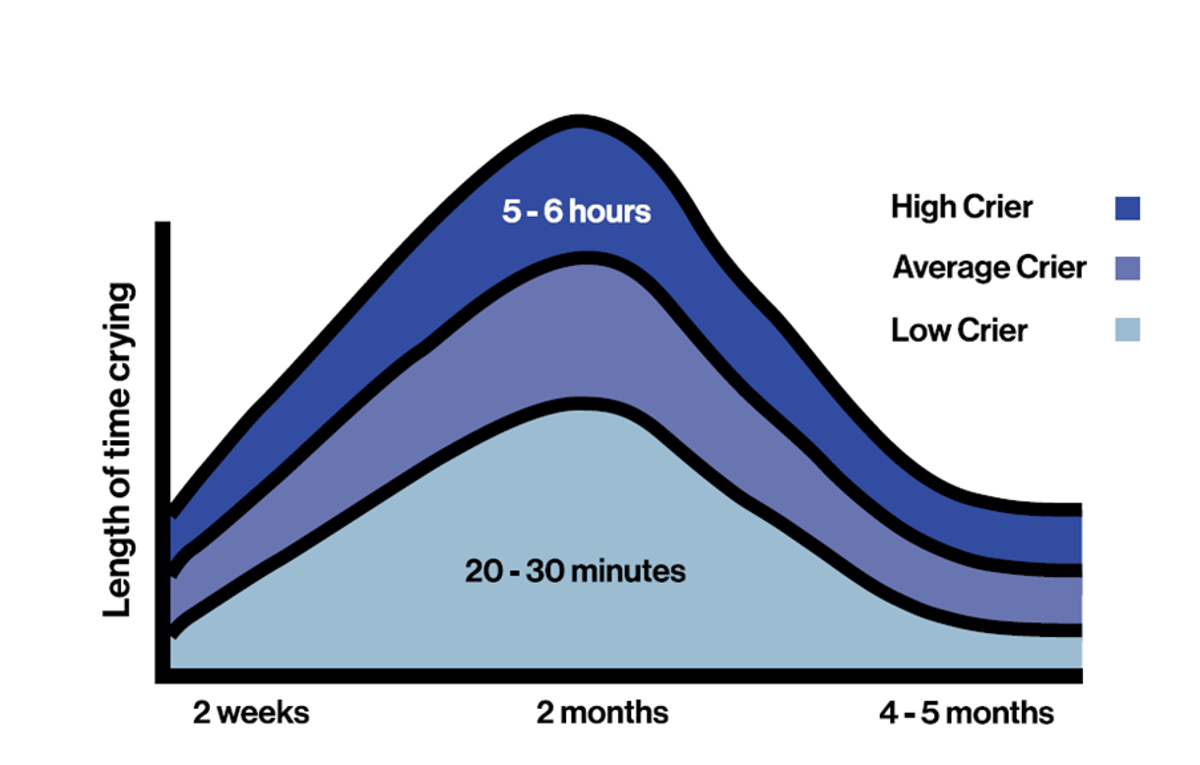
In the first 6 to 8 weeks it's very common for babies to cry for long periods, as shown by the normal crying curve.
If your baby was born prematurely, your baby may start to cry more frequently at about 2 weeks after the due date. The crying may get more frequent and last longer during the next few weeks, hitting a peak at about 6 to 8 weeks from the date when your baby was due to be born.
Every baby is different, but after about 8 weeks, babies start to cry less and less each week.
Diagram source: R G Barr, The normal crying curve - what do we really know? in Developmental Medicine and Child Neurology.
Crying characteristics
The characteristics of prolonged crying can be explained by the acronym PURPLE:
- P = Peak crying - your baby might cry more each week the most in the second month, then less in months three to five.
- U = Unexpected - crying can come and go and you don’t know why.
- R = Resists soothing - your baby might not stop crying no matter what you try.
- P = Pain-like face - a crying baby might look like they are in pain, even when they are not. Other symptoms include pulling up their legs, screaming, going red in the face and arching their back.
- L = Long lasting - crying can last as long as five hours a day or more.
- E = Evening - your baby might cry more in the late afternoon and evening.
There is no evidence that any of these will have long-term effects on your baby’s health and that it is very normal for your baby, but this can be a huge lifestyle change for you.
Coping mechanisms
It is hard to cope with a crying baby, especially if there is no obvious sign of why they are crying. Coping mechanisms can be great to help you deal with excessive crying in the early days.
No two babies are the same, and all respond to different methods of comfort. Trial and error may help you find the one that suits your baby - you may need to try more than one thing.
Get support with feeding if required from your midwife, health visitor or family nurse. They should carry out a breast or bottle feeding assessment for you just to make sure everything is going well with feeding.
Here are some other tips to support you:
- use skin-to-skin contact with you and your baby
- sleep when your baby sleeps
- use a sling following the TICKS guidance to support baby safely
- take baby for a walk in the pram, or a short drive in the car
- cuddle or gently rock baby
- sing or talk to baby, or play music
- use white noise, such as the washing machine
- give baby a warm bath
- try baby massage
- try to settle baby for sleep
Keep calm
It is normal to find crying stressful to listen to when it continues for a long time. Take the following things into consideration:
- For the first few weeks try and keep things as calm as possible. This is your time to get to know your baby, and for your baby to get to know you and the family.
- Get as much help and support as possible from family and friends.
- Be reassured that it is not your fault if your baby is crying for prolonged periods. Try not to compare yourself or your baby to others.
- When the crying becomes frustrating and you have tried everything to soothe your baby, it is important to take a break. If a trusted caregiver is not available to help with the baby for a while, put your baby in a safe place and take a few minutes to calm yourself down, but always go back and check on your baby.
- Never shake your baby. No matter how frustrated you feel, you must never shake your baby. Shaking moves their head violently and can cause brain damage.
If you are struggling to cope, do not be ashamed to ask for help. Talk to your partner or someone close to you. Your midwife, health visitor or family nurse are also there to talk to you about how crying is affecting you and they will support you to get help if you need it.
ICON - babies cry, you can cope (video)
When babies cry it can be stressful and overwhelming. Help is out there and all you need to do is ask.
I
Infant crying is normal and it will stop. Babies start to cry more frequently from around two weeks of age. The crying may get more frequent and last longer. After 8 weeks of age babies start to cry less each week.
C
Comfort methods can sometimes soothe the baby and the crying will stop. Think are they hungry, tired, or in need of a nappy change? Try simple calming techniques such as singing to the baby or going for a walk.
O
It’s OK to walk away if you have checked the baby is safe and the crying is getting to you. After a few minutes when you are feeling calm, go back and check on the baby.
N
Never, ever shake or hurt a baby. It can cause lasting brain damage or death. If you are worried that your baby is unwell contact your GP or call NHS 111.
Video: Preventing traumatic head injury in babies - from Public Health England in partnership with ICON.
Important: When to seek medical or emergency help
If your baby’s crying is continuous and you cannot console or distract them, or the cry does not sound like their normal cry, it could be a sign they are ill.
You know your baby best, and will know what are different or worrying behaviours. Seek help if you are very concerned, from your doctor, 111 or out of hours services.
Call 999 and ask for an ambulance if your baby:
- has a weak, high pitched continuous cry
- seems floppy when you pick them up
- is under 3 months old and has a temperature over 38°C
- Is between 3 and 6 months old and has a high temperature over 39°C
- has a high temperature, but their hands and feet feel cold
- has a bulging fontanelle (the soft spot on a baby’s head)
- has had a fit (seizure or convulsion)
- turns blue, mottled or very pale
- has difficulty breathing, breathes fast or grunts while breathing, or seems to be working hard to breathe
- has a spotty purple-red rash anywhere on the body (this could be a sign of meningitis)
More support
NHS Highland
The Perinatal and Infant Mental Health team hold webinars to support parents to cope with inconsolable crying.
Read more about Infant feeding.
ICON
- Advice for parents
- Infant crying and how to cope (pdf)
- Infant crying and how to cope (pdf) - for babies born prematurely
- How to manage when a baby cries (pdf, Easy Read format)
- How to manage when a baby cries (pdf, Easy Read format) - for babies born prematurely
Ask your health professional for a paper copy of these leaflets.
More resources
- Soothing a crying baby - from NHS UK
- Why is my baby crying? - from Parent Club (Scottish Government)
- Caring for your new baby - Crying - from NHS Inform
- Advice for families - from NSPCC